The Mutuals · The startup playbook
I took apart 5 apps people pay for.Here's the startup playbook.
Wispr Flow, Cluely, Similarweb, Zoom and WhatsApp: who really pays, how each one spreads, and what you can't copy. Plus the free kit that replaces $234 a month and runs on your laptop.
In none of the five apps I took apart was the AI the part worth paying for.
I took apart Wispr Flow, Cluely, Similarweb, WhatsApp and Zoom with an AI reverse-engineering tool, then rebuilt what I could with Claude Code. This is what they taught me about money, growth and the social side of apps, written as a playbook. And every tool I built, in one place, free.
What I found
- The AI is the cheapest part. Free whisper transcribes my voice in 0.9 seconds on my laptop. Cluely's $149.99 "undetectable" mode is one line of code. A free 2022 codec beat Zoom's own on my tests. What people pay for is everything around the model.
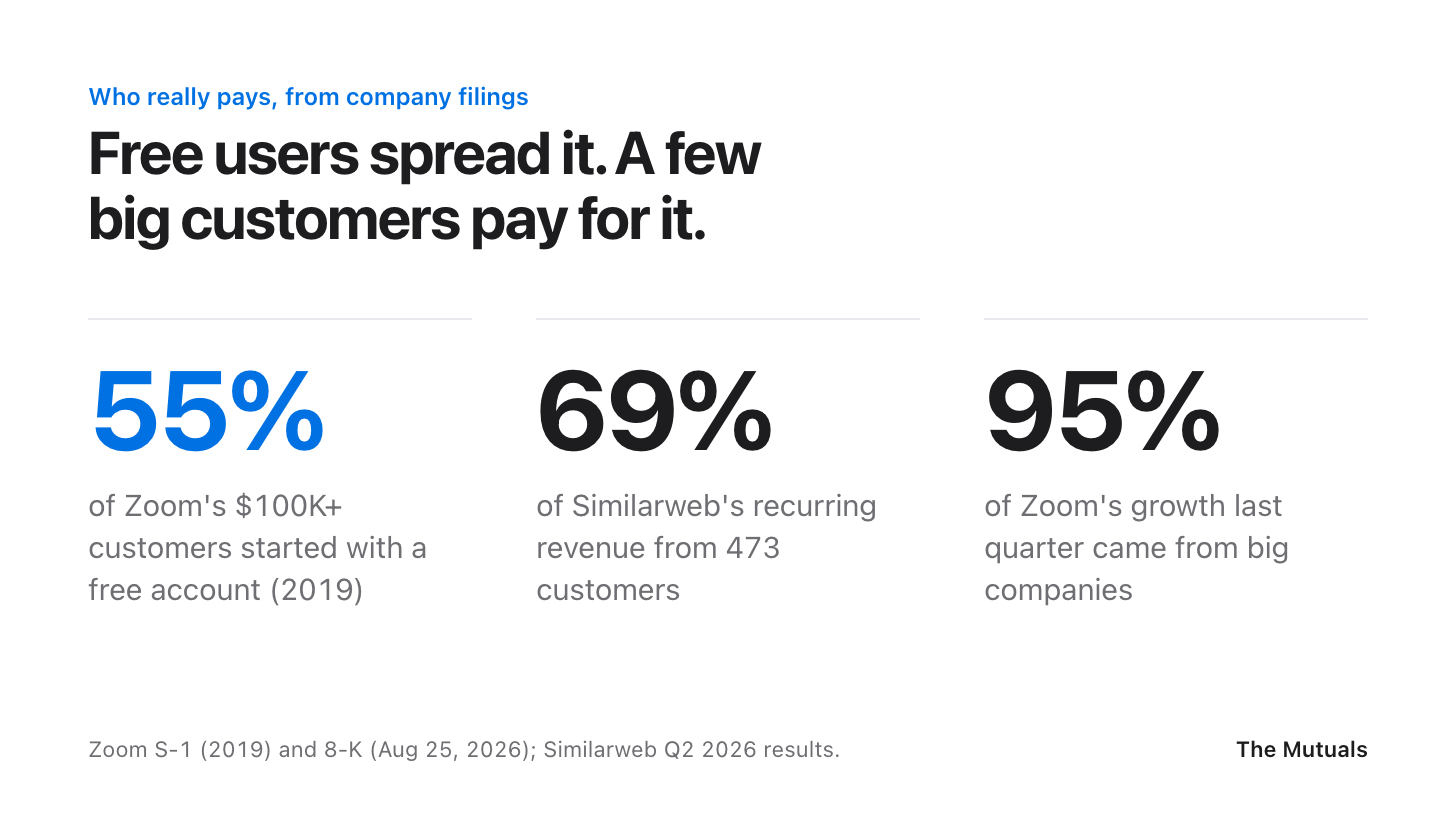
- The user is rarely who pays. WhatsApp is free; businesses pay per message. Similarweb gets 69% of its recurring revenue from 473 customers. At Zoom, 55% of its biggest customers started with a free account.
- If nobody else sees your app, you have to buy attention. Zoom and WhatsApp spread every time you invite someone. Cluely is built to be invisible, so it made about 200 short videos a day instead.
What you can do with it
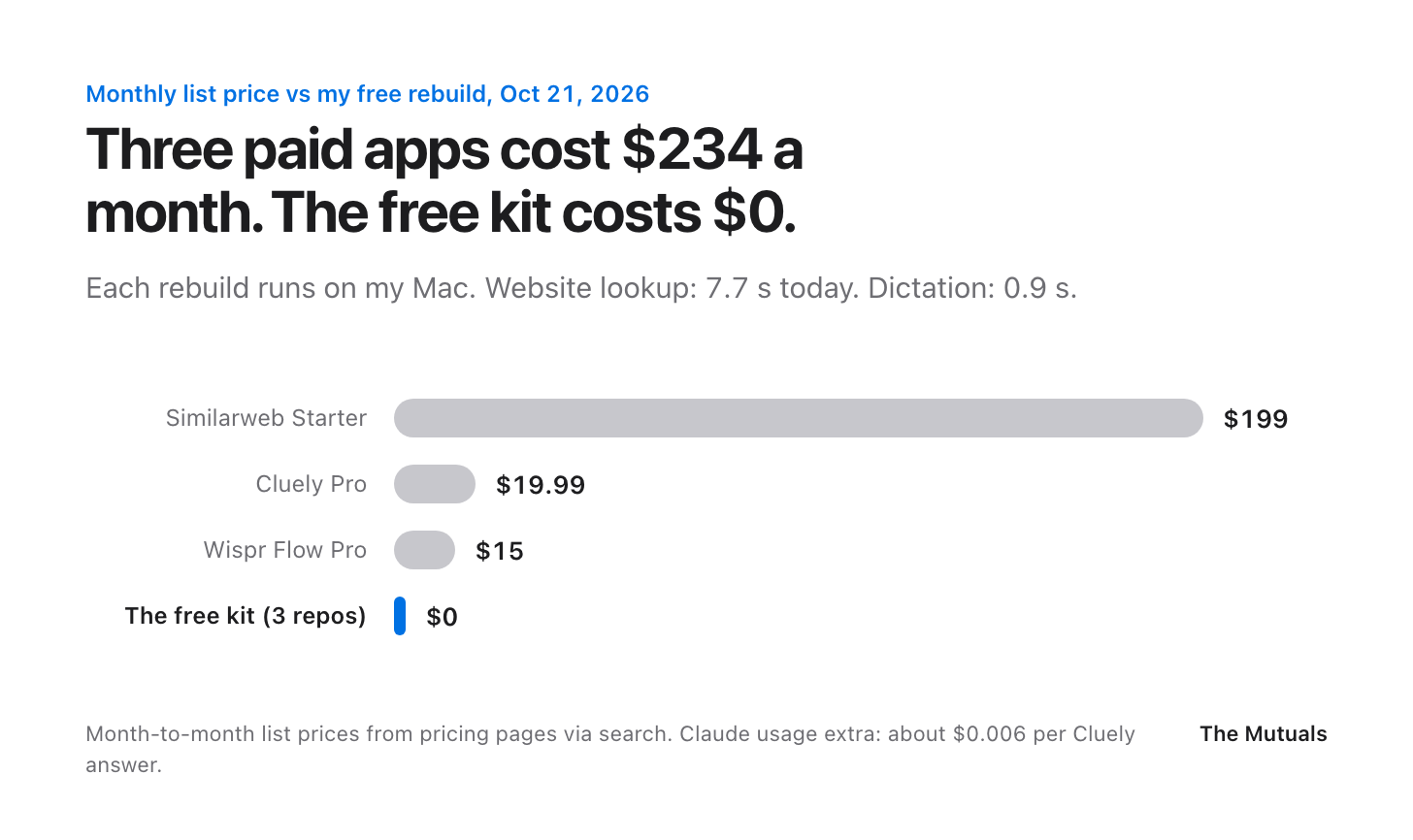
- Run the free kit: your own dictation app, call assistant and website-intel tool, $0 beyond your Claude plan.
- Find your free surface: list who sees your product besides the user. If the answer is nobody, budget for attention from day one.
- Find the payer who isn't the user: the company, the business on the other end, the advertiser.
- Check a startup's playbook in 8 seconds: look up any company's site and see its ad pixels and traffic trend. Granola's is below.
The free kit, replacing $234 a month
The trick: every paid app here is a free model plus plumbing. The model is now free and local. The plumbing is what Claude Code writes in an afternoon. Timings are from my M4 Pro in October 2026.
-
Dictationinstead of Wispr Flow, $15/month
Hold a key, talk, and clean text is typed wherever your cursor is. Whisper turns speech into text in 0.9 seconds on the laptop.
wispr-local on GitHub ↗ -
Call assistantinstead of Cluely, $19.99/month
Listens to "me" and "them" on any call with no bot joining, and answers when you ask. A line hits the transcript 1.6 seconds after someone stops talking; each answer costs about $0.006 of Claude.
cluely-local on GitHub ↗ -
Website intelinstead of Similarweb, $199/month
Popularity trend, tech stack, every tracker and ad pixel, any site. 7.7 seconds for granola.ai.
similarweb-local on GitHub ↗ -
See what your apps keepfree
whatsapp_peek.py(3.6 seconds: 92,815 messages back to 2018, in a plain database on my Mac) and zoom-local'szoom_peek(0.9 seconds: 24 AI models, 851 MB downloaded after install). Counts only, never your messages.
No code: paste this into Claude Code
Clone github.com/eliotb26/wispr-local, github.com/eliotb26/cluely-local and
github.com/eliotb26/similarweb-local into ~/kit. For each one, read the README,
run its quick start, and tell me what it needs from me (permissions, a key,
a model download). Then run similarweb-local on my company's website and on
my top two competitors, and give me a three-line comparison.
The part I didn't expect: the free versions aren't toys. Similarweb-style lookups, local dictation and a call assistant cover what most people actually use those products for. What I couldn't rebuild, every time, was the data: Similarweb's panel of millions of browsers, Zoom's years of network tuning, WhatsApp's 3 billion people.
Where it falls short: my versions have no team plans, no admin panel, no support, and no visit counts. That gap is the business, which is the playbook below.
The playbook: what five apps teach about money and growth
-
The model is free. Charge for what's around it.
Wispr's edge is context: it reads 11 kinds of it (the app you're in, names on screen) to spell your coworker's name right. Cluely's edge is listening well. Zoom's is surviving bad Wi-Fi. If your pitch is "we use AI", someone like me rebuilds it in a day.
-
Free users are the sales team. A few big customers are the money.
Zoom's IPO filing said 55% of its 344 customers paying over $100,000 started with a free host, and those 344 brought 30% of revenue. Last quarter, big companies brought 95% of Zoom's growth while self-serve grew 0.6%. Similarweb: 473 customers paying $100K+ are 69% of its recurring revenue. The consumer side isn't the business. It's how the business finds you, so you can't skip it if your product spreads by use.
-
Pick one free surface and make it great.
Each app has one place where non-payers meet it:
- Zoom: the guest who joins with no account. That's why it builds an AI voice for the guest on bad hotel Wi-Fi.
- Similarweb: millions of free report pages built to rank on Google, plus a free extension with 1,000,000 users that also feeds its data.
- WhatsApp: your contacts. Free to you; businesses pay per message to reach you.
- Wispr: a free tier of 2,000 words a week.
-
Invisible products buy attention.
Cluely hides from screen share, so nobody discovers it in a meeting. It made attention instead: about 200 videos a day and a controversial pitch, to roughly $5.2M a year (its founder later walked back a $7M claim). Build in a way others see it, or plan for that marketing bill.
-
Own something nobody can download.
Every rebuild hit the same wall: a browsing panel, years of call data, a network of people. Start collecting yours on day one: usage data, a community, integrations.
For investors, three questions
Does the product cross company lines (so use is distribution)? What share of the biggest customers started free? Do existing customers spend more each year? Zoom's answer went from 140% in 2019 to 99% now: the free engine did its job, and growth now has to come from new products.
Startup radar: Granola is set up for ChatGPT ads
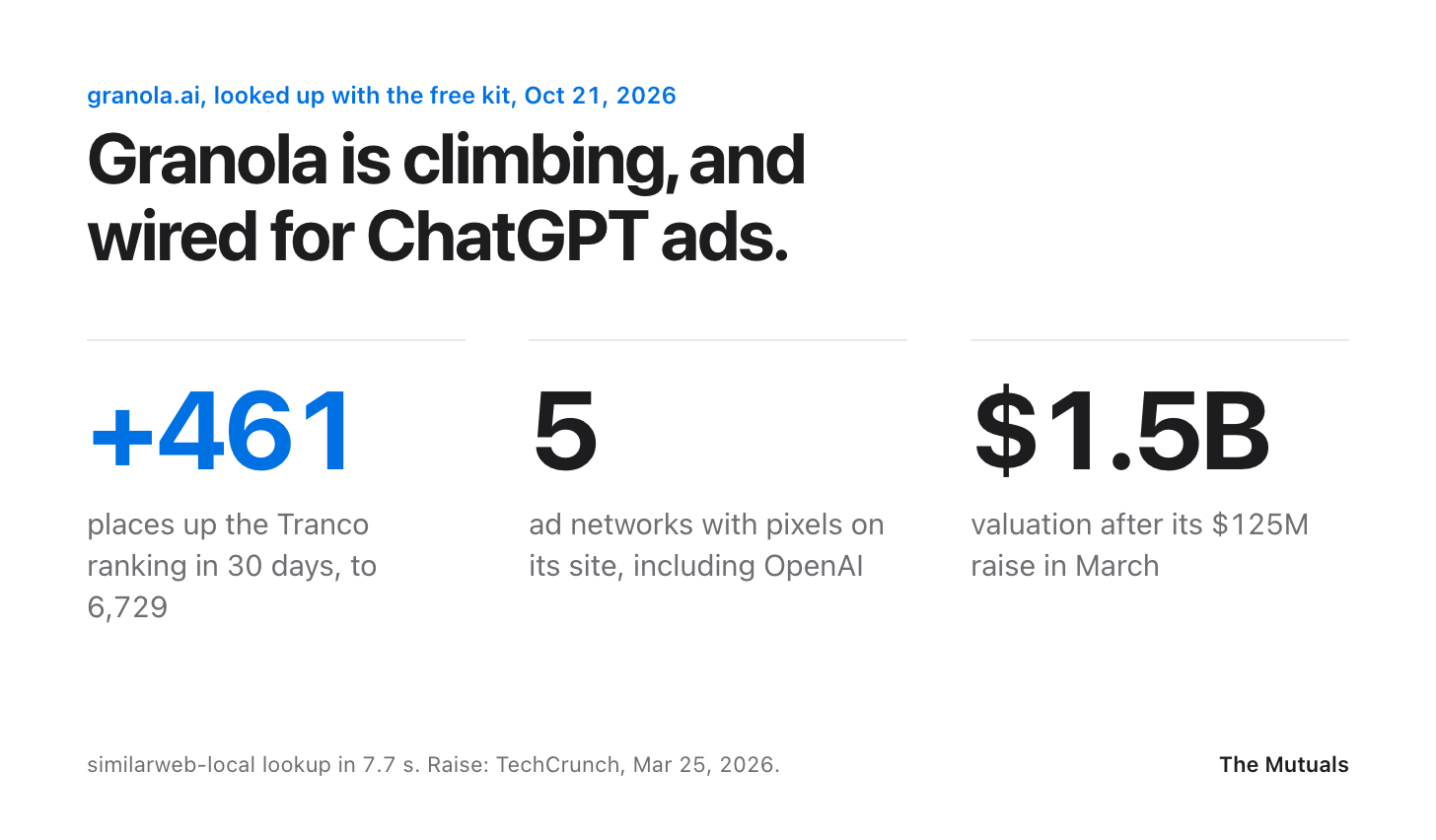
Granola, the AI notepad for meetings, raised $125M at a $1.5B valuation in March (TechCrunch). I ran the kit's website lookup on granola.ai on Oct 21, 2026:
- It's climbing. Its Tranco rank, a free research ranking of the top million sites, went from 7,190 to 6,729 in 30 days, up 461 places.
- It's wired for paid ads on five networks. Ad pixels from LinkedIn, Meta, Microsoft, Google and OpenAI. OpenAI's pixel is how advertisers measure ads inside ChatGPT, so Granola looks set up to advertise to people asking an AI about meetings.
- The playbook fits. Granola is used alone, on your own laptop, with no bot in the call: nobody sees it working. So, like Cluely, it has to buy attention. Unlike Cluely, its notes get shared, and its raise was framed around expanding to enterprise. Free user in, company contract out.
Next up: Granola. I'll take the app apart and rebuild it.
Perks from Atrios
If you're a founder or decision maker at a funded US startup, these are for you. Each comes with a perk when you go through my page:
- Monaco: the AI-native CRM that replaces legacy CRM and scattered sales tools. $2,000 welcome bonus + a 1:1 GTM teardown.
- Deel: hiring, payroll and HR in 150+ countries. $1,500 in partner credits + a $250 welcome bonus.
- Rho: banking and finance automation for startups. $875 welcome bonus.
- Automat: an AI employee that works in your existing tools.
- Numeral: autopilot your sales tax.
I only list tools I'd hand a friend.